HTR Bamboo · Cabinet buyer brief
Bamboo Kitchen Cabinets: Panel Specification & OEM Sourcing
Define the cabinet part, construction, finished dimensions, machining, appearance, finish, quantity and destination before comparing suppliers. HTR reviews the actual drawing and confirms which panels or components can be quoted.
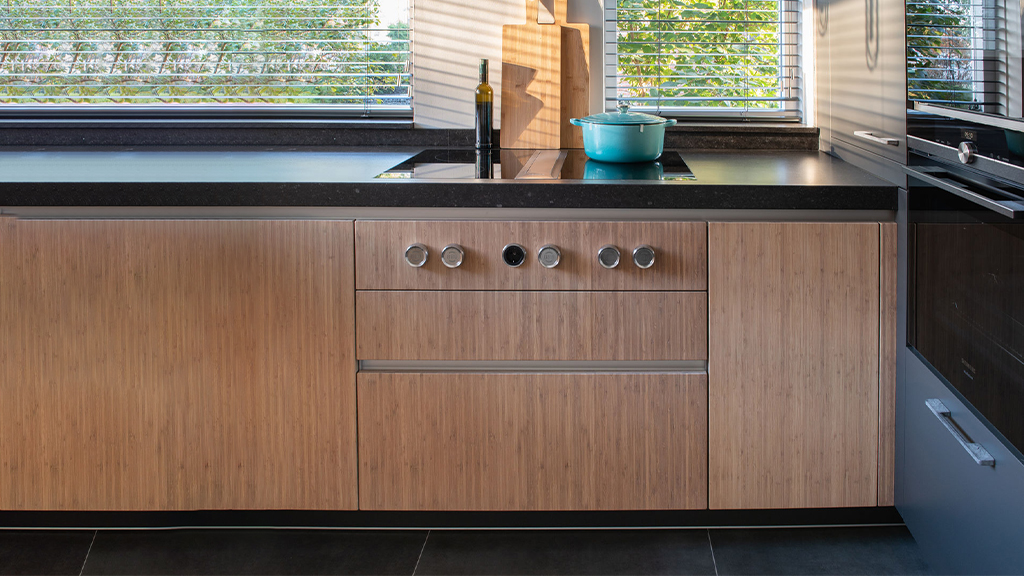
For a bamboo kitchen cabinet programme, first state whether you need full sheets, cut-to-size parts, doors or fronts, exposed end panels, or a broader finished assembly. Then provide drawings, dimensions, layer construction, grain and colour, finish, hardware or machining points, quantity, packing and destination. HTR confirms feasibility, sample scope, documents and commercial terms for the quoted configuration.
Start with the component
Three cabinet uses, three different acceptance points
Cabinet carcasses and shelving
Provide span and support, finished size, edge exposure, hardware positions, machining route and the service environment. Thickness alone does not define a suitable build.
Doors, fronts and end panels
Define visible face quality, grain direction, colour range, component size, edge detail, tolerance and finish. Approve appearance on a physical sample.
Cut parts or finished assemblies
Send a drawing or bill of materials, hardware and assembly responsibility, packing method and destination. HTR confirms in writing which part of the requested scope can be supplied.
Quote-ready input
Put these decisions in the RFQ
| Application | Cabinet box, shelf, door/front, end panel, drawer part, worktop or another defined component; include its support and use environment. |
|---|---|
| Finished dimensions | Length, width, thickness, tolerance, exposed edges, drilling, slots, cut-outs and hardware or machining points. |
| Panel construction | Solid laminated bamboo or bamboo-faced construction, layer build, core/backing, adhesive requirement and edge appearance. |
| Appearance | Natural or carbonised colour, vertical or horizontal grain, face expectation and the variation to approve by sample. |
| Finish | Unfinished, sanded or an agreed coating system; state who applies it and what the complete sample must demonstrate. |
| Commercial detail | Sample and production quantity, packing, target schedule, destination postcode or port, and preferred trade term. |
| Evidence | FSC claim, emissions or performance report, inspection record, composition statement or export document required for the exact quoted configuration. |
Availability, tolerance, MOQ, lead time, document scope and price are confirmed after specification review; this page does not set fixed order terms.
Decision route
Move from drawing to a controlled production brief
Send the component, drawing, build, quantity and destination.
Resolve construction, tolerance, finish, packing and document questions.
Agree the sample format, cost, courier terms and acceptance points.
Record the accepted specification, scope, trade term and timing in writing.
Performance boundary
Do not treat “bamboo” as a waterproof specification
Moisture response and service life depend on the complete panel construction, adhesive, coating, edge sealing, hardware, support, installation and exposure. State the cleaning and moisture context, then approve the proposed panel-and-finish system on a representative sample.
What the sample should prove
Use it to review appearance, construction and edge, machining or drilling, coating compatibility and prototype fit. A sample does not automatically prove destination compliance, every production tolerance or final freight and customs terms.
Buyer questions
Short answers for cabinet programmes
What should I specify for bamboo cabinet doors?
State component size, construction, thickness, grain and colour, visible face and edge, tolerance, hardware or machining points, finish and sample acceptance criteria.
Can HTR quote cut parts or finished cabinets?
Send the drawing or bill of materials and define machining, hardware, assembly, packing and destination. HTR confirms which panels, components or selected OEM scope can be quoted; do not assume a turnkey package from the page title.
Which documents should I request?
Start with the quoted composition and specification, then request only the FSC claim, emissions/performance report, inspection or export document that applies to that configuration and destination.
When should I use a standard panel brand?
Use a listed standard product when its published construction, dimensions and local availability fit the job. Use a custom route when drawings, machining, appearance, sample acceptance or repeat-order controls must be reviewed together.
Connected evidence
Keep the same configuration across every buying step
Technical catalogsPanel references and the inputs needed for a useful quotation.
Document scopeMatch FSC, test and export evidence to the actual order.
Bamboo plywood optionsReview construction, dimensions, appearance and applications.
Representative sampleDefine what the sample must help you decide before dispatch.
Shipping planningReview MOQ, packing, lead-time and destination variables.
Production review
Have a cabinet drawing or component list?
Send the application, finished dimensions, construction, appearance, finish, machining, quantity, destination and required documents. HTR will confirm the review scope before quotation.
Share This Story, Choose Your Platform!
About the Author: HTR Bamboo Editorial Team

Related Posts
On this page
Need bamboo specifications?
Latest Posts
Copyright 2020 – 2030 HTR Bamboo
All Rights Reserved!

 English
  German
  Spanish
  Vietnamese