Quick answer: this guide explains bamboo plantation for buyers in 2026, covering the key facts, trade-offs, and sourcing tips you need before you decide.
The Economic Impact of Bamboo Plantations on Local Communities: A Comprehensive Market Analysis
Bamboo is no longer just a traditional material—it has evolved into a strategic asset in the global sustainable materials economy. For investors, processors, and rural development agencies, understanding the economic viability of bamboo plantations is crucial. Bamboo’s rapid growth, diverse revenue streams, and increasing demand for engineered bamboo products create compelling opportunities for sustainable investment and community upliftment.
This article explores the bamboo plantation economics, the socio-economic benefits for local communities, and the critical factors shaping the bamboo value chain. We also examine emerging models such as outgrower schemes and MSME development, highlighting how bamboo cultivation supports rural livelihoods while contributing to climate goals through carbon credits and green building procurement.
Why Bamboo Plantations Matter for Sustainable Resource Management
Bamboo’s unique biological characteristics—fast growth cycles of 3 to 5 years and regrowth from rhizomes—make it an exceptionally renewable resource. This rapid renewability supports sustainable bamboo cultivation practices that reduce pressure on forests and promote soil conservation.
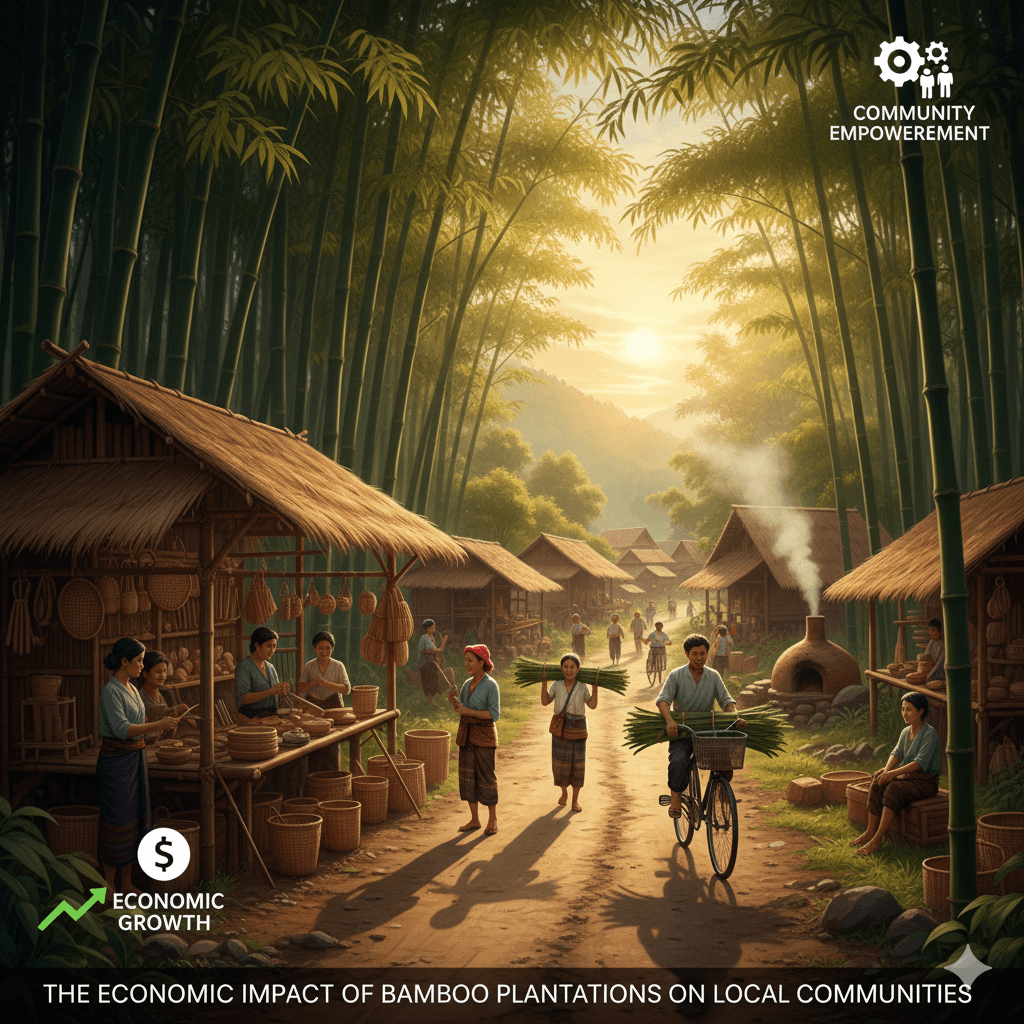
Moreover, bamboo plantations generate significant bamboo farming community benefits by creating year-round employment opportunities, fostering smallholder engagement, and enabling value addition close to the source. This creates a virtuous cycle where economic development and environmental stewardship reinforce each other.
Market Overview and Demand Drivers
The global demand for bamboo and bamboo-derived products is expanding across multiple sectors:
- Construction materials: Engineered bamboo panels, flooring, and laminated bamboo lumber are increasingly specified for their durability and low embodied carbon.
- Furniture and textiles: Bamboo’s versatility supports a growing market for eco-friendly furniture and sustainable textiles.
- Energy and biochar: Residual biomass is converted into bamboo biochar, contributing to soil health and carbon sequestration.
- Carbon markets: The ability to generate carbon credits bamboo incentivizes sustainable plantation management.
Policy momentum around green building procurement and climate commitments further accelerates bamboo adoption globally.
Bamboo Plantation Economics and ROI Scenarios
Economic viability depends on several factors:
- Establishment costs: Initial investments include nursery setup, planting, irrigation, and labor.
- Yield and revenue diversification: Income streams include poles for construction, engineered bamboo feedstock, fiber for textiles, biochar, and carbon credits.
- Processing proximity: Local processing reduces transport costs and increases value retention within communities.
- Risk management: Diversified offtake agreements and sustainable management practices stabilize returns.
Typical ROI ranges from mid-single-digit for pole-only models to low double-digit for integrated estate-to-product operations.
Enhancing Bamboo Plantation Profitability through Sustainable Practices
Key to long-term success is adopting sustainable resource management approaches:
- Moisture control and borate treatment ensure culm durability and pest resistance.
- Adherence to quality standards for bamboo (e.g., ISO 22156 and ISO 22157) guarantees product performance.
- Transparent traceability and documentation build trust with buyers and enable certification.
- Community-focused models like outgrower schemes and MSME development foster inclusive growth and empower rural economies.
Subjective Insights: Bamboo’s Transformative Potential
From my professional experience, bamboo plantations represent a unique intersection of environmental sustainability and socio-economic development. They offer scalable solutions to climate change mitigation through carbon sequestration, while simultaneously driving rural development and poverty alleviation.
However, realizing this potential requires coordinated efforts across the bamboo value chain, from responsible cultivation and ethical sourcing to advanced bamboo processing and market access. Supporting local communities with fair pricing and co-design opportunities is essential to preserving traditional knowledge and ensuring equitable growth.
Conclusion: Bamboo Plantations as Engines of Sustainable Growth
The economic impact of bamboo plantations extends far beyond timber production. By integrating sustainable cultivation, modern processing, and robust supply chain management, bamboo plantations can deliver significant environmental benefits and transformative social outcomes.
For investors and stakeholders committed to low-carbon materials and circular economies, bamboo represents a resilient, profitable, and ethical opportunity. As global markets and policies increasingly favor sustainable products, bamboo’s role as a cornerstone of green industry and community prosperity will only strengthen.
Further reading: Bamboo (overview). See also HTR Bamboo’s bamboo plywood and FSC certifications for more on bamboo plantation.
Working with a supplier? HTR Bamboo offers bamboo product range for B2B wholesale and OEM, or request a quote.
Share This Story, Choose Your Platform!
About the Author: HTR Bamboo Editorial Team

Related Posts



Table of Content
Need bamboo specifications?
Latest Posts
Copyright 2020 – 2030 HTR Bamboo
All Rights Reserved!

 English
  German
  Spanish
  Vietnamese