Quick answer: to cut a bamboo countertop cleanly, confirm the panel construction and final drawing, support the workpiece, use a sharp blade and straight guide selected for that panel, control the visible and exit edges, then inspect and seal exposed edges with a finish compatible with the intended use. Validate the method on an offcut or representative sample before cutting production parts.
How to Cut Bamboo Countertops: OEM Cutting Checklist
Bamboo countertops are manufactured panels, so machining behavior depends on thickness, layup, adhesive, grain direction, surface finish and moisture condition. Treat the instructions below as a planning checklist; the panel supplier, tool manufacturer, approved drawing and site-safety requirements control the actual process.
Before cutting: confirm the countertop specification
- Construction: record the quoted panel type, thickness, layer orientation, adhesive and finished faces.
- Drawing: confirm final dimensions, sink or hob cutouts, corner radii, edge profile, joints, overhangs and installation clearances.
- Finish: identify which faces and edges are prefinished and which newly exposed edges must be sealed after machining.
- Validation piece: use an offcut or representative sample from the approved configuration to check blade choice, feed, splintering and finish compatibility.
Cutting workflow
- Review the drawing and panel orientation. Mark the visible face, grain direction, cut line, waste side and protected edges before setting up.
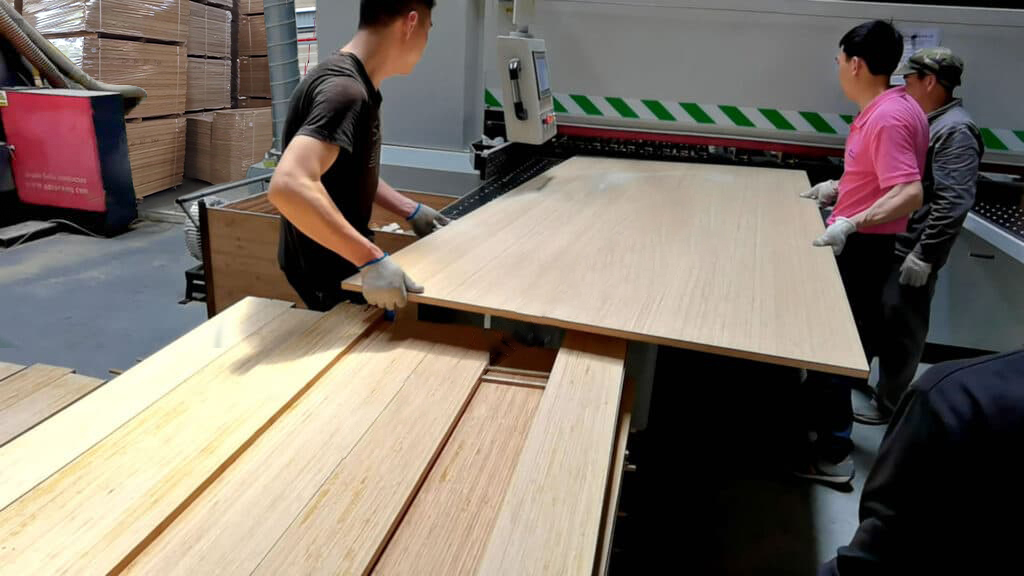
- Support and secure the panel. Use a stable surface and clamps or fixtures that prevent movement and support both sides of the cut.
- Select the tool and blade for the quoted panel. Follow the panel and tool supplier instructions; a sharp, appropriate fine-cut blade and dust extraction are normally part of the setup.
- Protect the visible and exit edges. Use a straight guide and, where the approved method permits, a sacrificial backer or surface protection to reduce tear-out.
- Set the cutting path and depth. Confirm clearances, guide position and blade depth against the tool manual and the actual panel thickness.
- Make the cut with a stable feed. Do not force the tool. Pause if the panel moves, the blade overheats or the cut quality changes.
- Machine cutouts to the drawing. Preserve the specified corner radii, distances from edges and installation clearances; use the approved drilling or routing sequence.
- Inspect, finish and record. Check dimensions, edge quality and damage, then sand and seal exposed edges only with the approved finish system.
Safety: cutting creates dust and exposes rotating tools. Use trained personnel, extraction, guards and the eye, hearing and respiratory protection required by the tool instructions, material safety information and local rules.
Can bamboo countertops be cut on site?
They can be site-cut when the installer has the approved drawing, suitable support, tooling, dust control and a method for sealing exposed edges. Repeated parts, tight tolerances, finished edge profiles or complex cutouts are usually better reviewed for factory cut-to-size or CNC machining before shipment.
What should an OEM drawing specify?
Provide overall dimensions, thickness, grain direction, visible faces, cutouts, corner radii, edge profiles, tolerances, finish scope, hardware holes, labels and packing orientation. For sinks, hobs or other appliances, use the current equipment template and confirm installation clearances with the responsible fabricator.
OEM cut-to-size approval checklist
- Panel: construction, thickness, grain, finish, moisture condition and acceptable appearance range.
- Machining: drawing revision, tolerances, cutouts, radii, holes, edge profiles and visible-face orientation.
- Validation: approved sample or first article, measurement method, edge-sealing system and acceptance record.
- Delivery: part labels, protective film, separators, corner protection, crate/pallet plan and destination handling.
Request a cut-to-size review
Send HTR Bamboo the panel construction, thickness, drawing, quantity, finish, tolerance and destination. We will confirm which panel and machining options can be reviewed for the quoted program.
Send your countertop cutting specification →
Related buyer paths: bamboo kitchen countertop reference, representative sample request, finish approval guide and Catalog Center.
Share This Story, Choose Your Platform!
About the Author: HTR Bamboo Editorial Team

Related Posts
On this page
Need bamboo specifications?
Latest Posts
Copyright 2020 – 2030 HTR Bamboo
All Rights Reserved!

 English
  German
  Spanish
  Vietnamese