FSC, CARB & EUDR: A 2026 Bamboo Compliance Guide for Importers
For importers doing due diligence, bamboo certification for plywood and panels usually comes down to four things: a valid FSC chain-of-custody claim, formaldehyde emission compliance for your market, a clear answer on EUDR scope, and the CE or EN documentation your specifiers ask for. This guide walks DE, EU and US buyers through each one and ends with a document checklist you can send to any supplier before you place an order.
The goal here is practical, not legal. We tell you what to request, how to verify it, and where the common gaps are. For final classification questions, confirm with your customs broker.
FSC and chain-of-custody
FSC stands for Forest Stewardship Council. For a manufactured product like bamboo plywood, the relevant scheme is FSC Chain-of-Custody (CoC), which tracks certified material from the certified source through every processing and trading step to the finished panel. A factory that holds CoC certification can sell FSC-labelled product; a factory that does not hold it cannot make an FSC claim, even if the raw bamboo came from a certified forest.
The most important habit for any importer is to verify the FSC code yourself. Every certificate holder has a unique code, and you can check it for free at search.fsc.org. Enter the code, confirm the company name matches your supplier, confirm the certificate is valid (not expired or suspended), and confirm the product types and species are listed in scope. HTR Bamboo’s FSC code is FSC-C210923, and you should treat any supplier’s code the same way before relying on it.
What “FSC certified bamboo plywood” means in practice
An FSC claim on bamboo plywood is only meaningful if four things line up. Ask any supplier for all four, and check them yourself:
- A licence code in the form FSC-C######, which identifies the certificate holder.
- A certificate number issued by an accredited certification body, which is what you look up.
- A claim type — FSC 100%, FSC Mix or FSC Recycled. For bamboo panels the strongest is FSC 100%.
- A product scope that actually lists the product you are buying. A certificate covering plywood does not automatically cover veneer, flooring or countertops.
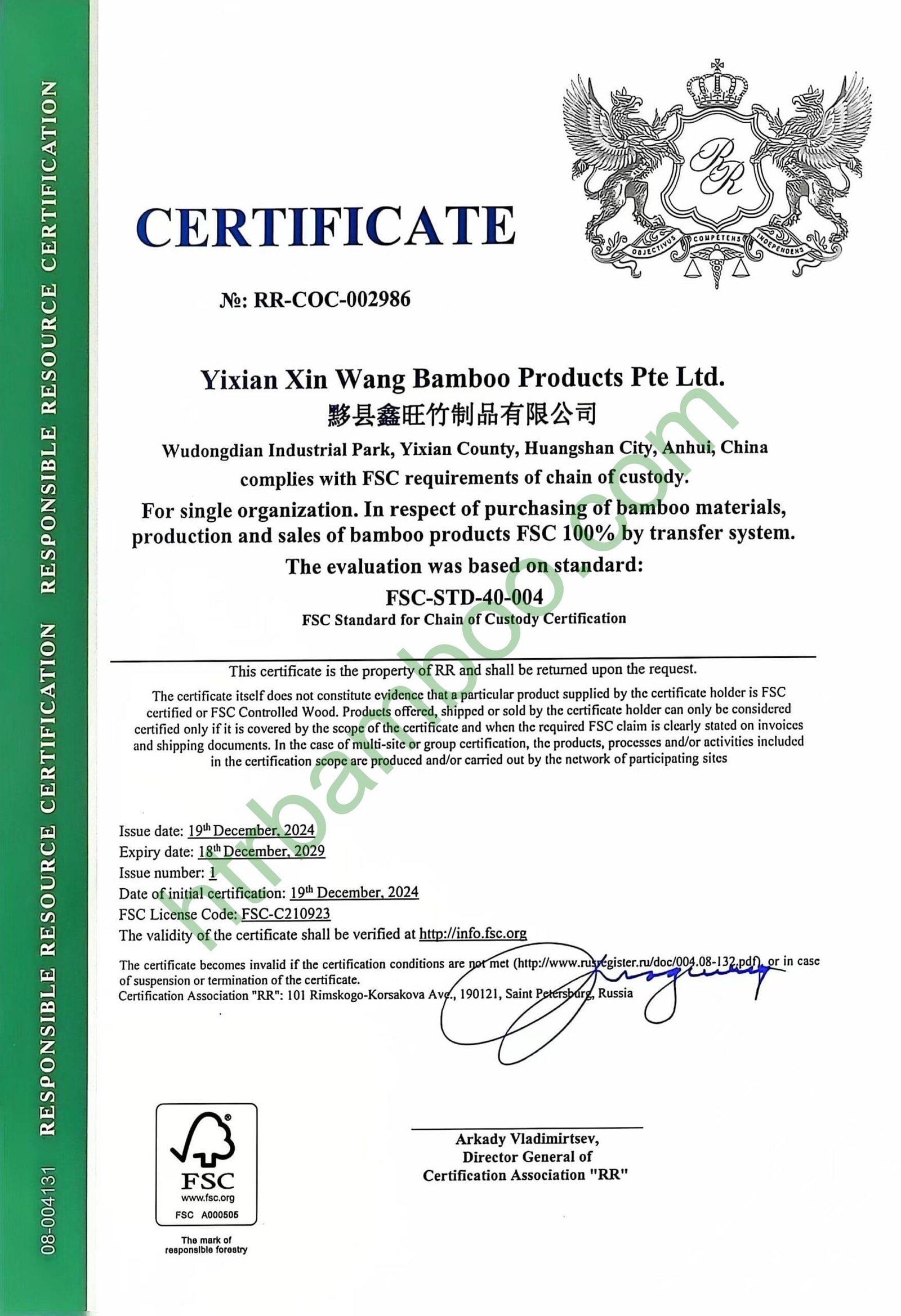
For reference, here is our own certificate in full, so you can see what a complete answer looks like:
| FSC licence code | FSC-C210923 |
| Certificate number | RR-COC-002986 |
| Standard | FSC-STD-40-004, Chain of Custody |
| Claim type | FSC 100% (by transfer) |
| Valid | 19 December 2024 to 18 December 2029 |
| Certified products | Bamboo plywood and bamboo articles |
| Certified factory | Yixian Xin Wang Bamboo Products, Anhui, China — HTR Bamboo’s joint-venture facility |
| Verify at | search.fsc.org |
Two honest notes on scope, because this is where most FSC claims quietly break down. First, our certificate covers bamboo plywood and bamboo articles — it does not cover veneer, flooring or countertops, and we will tell you that rather than let an FSC logo imply more than it should. Second, a certificate proves the factory is entitled to make FSC claims; it does not prove that your particular order was produced as FSC material. That is why the per-shipment claim on the invoice matters more than the certificate itself.
When you buy FSC material, ask that the FSC claim appears on the commercial invoice for each shipment. A certificate on the wall is not the same as a per-shipment claim on your paperwork, and your own FSC reporting depends on that invoice language.
Formaldehyde: E0, E1, CARB Phase 2 and TSCA Title VI
Composite bamboo panels and many plywood products use adhesives, so formaldehyde emissions are regulated in most markets. The terms you will see fall into two families.
European EN classes
In Europe, emissions are commonly described as E1 or E0 under the EN classification. E1 is the long-standing European limit class for panels; E0 is a stricter, lower-emission tier that many buyers now specify by contract. These are commercial and standards terms rather than a single EU law, so state the exact class you require in your purchase order.
US limits: CARB P2 and TSCA Title VI
For the United States, the reference points are CARB Phase 2 (the California Air Resources Board limits) and US EPA TSCA Title VI, the federal emission standards for composite wood products. TSCA Title VI is harmonised with CARB Phase 2 limits and applies nationwide, so US importers should ask for test reports and the relevant labelling that demonstrate conformity for the panel type they are buying.
Whatever your market, request the actual emission test report tied to the product and adhesive system you are ordering, not a generic statement. We do not quote specific test values here because they vary by product and batch; the document to obtain is the lab report itself.
EUDR and bamboo
This section is a summary. For the full position — what the European Commission actually wrote, why a 4412 customs code does not create an obligation, and where the exemption stops for bamboo-faced panels with a wood core — see does the EUDR apply to bamboo plywood?
The EU Deforestation Regulation (EUDR) sets due diligence obligations for a defined list of commodities, including wood and many wood products. A practical point for bamboo buyers: bamboo is botanically a grass, not a tree, so pure all-bamboo products are generally treated as outside the timber scope of EUDR. For many importers, that can simplify due diligence.
Do not over-rely on that, though. Your product’s exact tariff classification, any non-bamboo components, and your own role in the supply chain all affect how EUDR applies to you. Confirm your specific product’s classification with your customs broker, keep documentation on the bamboo origin and processing, and retain it as you would for any regulated import. Good records cost little and protect you if a classification is ever questioned.
CE marking and EN standards for panels and flooring
Specifiers and main contractors in the EU often ask for harmonised standard documentation, especially on construction projects. Two standards come up most for bamboo:
- EN 13986 covers wood-based panels for use in construction and is the reference for CE marking of structural and non-structural panels.
- EN 14342 covers wood and parquet flooring and the characteristics that must be declared, including reaction to fire and formaldehyde release.
If your project requires CE marking, ask whether the supplier can provide a Declaration of Performance and the test basis behind it for the specific panel or flooring product. Not every bamboo product needs CE marking, so check what your end use and your customer actually require before specifying it.
Document checklist to request from any supplier
Send this list with your enquiry. A capable manufacturer can produce most of it quickly, and the speed and clarity of the response tells you a lot about the supplier.
| Document | What it proves |
|---|---|
| FSC Chain-of-Custody certificate and code | Supplier can make an FSC claim; verify the code at search.fsc.org |
| FSC claim wording for the invoice | Each shipment carries a valid per-shipment FSC claim |
| Formaldehyde test report (E1/E0, CARB P2, TSCA Title VI as relevant) | Emissions meet your destination market limits |
| Product specification and species declaration | Material, construction and species match your order |
| EN 13986 / EN 14342 declarations (if required) | Suitability for construction or flooring use and CE basis |
| EUDR-relevant origin and processing records | Traceability to support your own due diligence |
| Test reports for performance (bond, density, moisture) | The product performs as specified for your application |
How to vet a bamboo supplier’s certifications
Use a consistent process for every new supplier. The steps below take less than an afternoon and prevent most surprises at the port.
Step 1: Verify the FSC code independently
Look up the code at search.fsc.org, confirm the legal name matches, check validity and scope. Do this before you discuss price, not after.
Step 2: Match the certificate scope to your product
A valid certificate that does not list your product type or species does not cover your order. Confirm the bamboo plywood or flooring you want is inside the scope.
Step 3: Request the actual test reports
Ask for the formaldehyde and performance reports tied to the exact product and adhesive system. A real lab report names the product, the method and the lab.
Step 4: Confirm market-specific compliance
For US orders, confirm CARB P2 and TSCA Title VI. For EU orders, confirm the EN class you need and any CE or EN 13986 / EN 14342 requirements from your specifier.
Step 5: Settle EUDR classification with your broker
Share the product details with your customs broker, confirm how EUDR applies to your specific item, and file the supporting origin documents.
How HTR Bamboo supports compliance
HTR Bamboo is an FSC-certified manufacturer and exporter under FSC-C210923, supplying B2B wholesale and OEM/ODM buyers in Germany, Australia and the United States. We provide FSC chain-of-custody documentation and per-shipment claims on request, and we can supply formaldehyde and performance test reports for the specific product and adhesive system you order.
For OEM and ODM programmes, we prepare the documentation pack your import and resale process needs, including product specifications and species declarations.
If your project calls for EN-based declarations on panels or flooring, tell us the standard and end use and we will confirm what we can support. You can review our core ranges on the bamboo plywood and strand woven bamboo flooring pages, and we will align the paperwork to your destination market.
Honest documentation is part of how we work. Where a requirement does not apply to a pure bamboo product, we will say so rather than over-claim, and we encourage you to verify every certificate yourself.
Get a compliance-ready quote
Tell us your product, your destination market and the certifications your buyers require, and we will return a quote with the matching FSC bamboo and test documentation. Start on our contact page and we will reply with the paperwork you need to clear due diligence.
Bamboo certification: the documents buyers verify
Bamboo certification is the foundation of a credible supply chain. Strong bamboo certification means an FSC Chain-of-Custody number you can verify, plus formaldehyde test reports (E0/E1, CARB Phase 2, TSCA Title VI). For European importers, bamboo certification also intersects with EUDR due diligence. Asking for full bamboo certification up front protects you from customs delays. HTR Bamboo backs every order with complete bamboo certification and compliance paperwork.
Bamboo certification: frequently asked questions
Is HTR Bamboo’s plywood FSC certified?
Yes. HTR Bamboo holds FSC Chain-of-Custody certification under licence code FSC-C210923, certificate RR-COC-002986, valid from 19 December 2024 to 18 December 2029. The claim type is FSC 100% by transfer, and the certified products are bamboo plywood and bamboo articles, produced at our joint-venture facility Yixian Xin Wang Bamboo Products in Anhui, China. You can verify all of this independently at search.fsc.org. The certificate does not cover bamboo veneer, flooring or countertops, and we do not make FSC claims on those.
How do I verify that bamboo plywood is really FSC certified?
Look up the supplier’s licence code at search.fsc.org, then check four things: the company name matches the supplier you are actually buying from, the certificate is valid rather than expired or suspended, the product scope includes bamboo plywood specifically, and the claim type is stated. Finally, require the FSC claim to appear on the commercial invoice for each shipment. A valid certificate alone does not make a given shipment FSC material.
Share This Story, Choose Your Platform!
About the Author: HTR Bamboo Editorial Team

Related Posts
Table of Content
Need bamboo specifications?
Latest Posts
Copyright 2020 – 2030 HTR Bamboo
All Rights Reserved!

 English
  German
  Spanish
  Vietnamese