How to Prevent Mold & Moisture Damage in Bamboo Panels: Expert Guide

Introduction
Overview
As Vice President of Engineering & Research at HTR Bamboo, I lead our innovation in sustainable bamboo solutions. Bamboo panels are used across construction, interior, furniture and craft applications; mold and moisture outcomes depend on construction, finish, storage, service environment and maintenance. In our ongoing efforts to enhance product longevity, we continually refine techniques to prevent mold moisture damage in bamboo panels, addressing common issues such as mold susceptibility, blackening, and moisture-related degradation that challenge manufacturers and exporters alike.
Purpose and Audience
This bamboo panel mold prevention guide is designed for B2B partners including exporters, importers, distributors, factories, and warehouse owners and B2C partners like architects, construction companies, and homeowners aiming to enhance longevity and ensure proper maintenance of high-quality bamboo panels.
HTR Bamboo publishes application-specific guidance for bamboo panels exposed to moisture. Review the panel construction, finish, storage and service conditions before specifying an order; use the bamboo plywood route to confirm options for the quoted configuration.
Understanding Bamboo Panel Deterioration
Causes of Mold, Blackening and Moisture Damage
Mold risk depends on moisture availability, temperature, contamination, airflow, storage and finish condition; assess the panel under the actual service environment rather than treating every bamboo panel as universally mold-prone.
Mold or blackening can occur during harvest, storage, transport, processing or use when moisture and contamination are not controlled; a study result or treatment recommendation must not be transferred automatically to every panel.
For a commercial order, select treatment and finish only after checking material compatibility, regulatory requirements and test evidence. While many inorganic and organic preservatives are used to increase mold resistance, only a few are effective as bamboo mold inhibitors because most of them are developed for other woods (Yu et al, 2022).
For bamboo manufacturers, suppliers, and exporters, mold infestation reduces the quantity and quality of harvested bamboo wood and manufactured bamboo panels. For the end-users and consumers, this leads to costly repairs and replacements.
Preventive Maintenance Techniques
Common Methods in the Bamboo Industry
At HTR Bamboo, we emphasize evidence-based best practices. The table below shows research results and their implications to commonly used methods for protecting bamboo panels from mold, blackening, and moisture damage.
| Research Reference | Method | Benefit | Action |
|---|---|---|---|
| Yu et al (2022) | Citric Acid Treatment | reduces starch and sugar content | Research reference only; validate concentration, process controls, panel compatibility and local requirements before use. |
| Yang et al (2019) | Copper (II) Chloride-Grafted Silica Gel | serves as antifungal film | Research reference only; require formulation, worker-safety, disposal and performance validation before use. |
| Xu et al (2013) | ACQ/CCA Preservative Treatment | serves as a preservative to improve mold resistance | Do not substitute preservatives from this table; use only a legally permitted, labeled system validated for the quoted panel and destination. |
| Yang et al (2019) | Sol-Gel Method | serves as a protective coating for long-term mold resistance | Research reference only; lab and regulatory validation are required before any commercial coating decision. |
From the table above, These papers describe methods tested under their own conditions; they are not universal production instructions or a guarantee of mold protection for every panel.
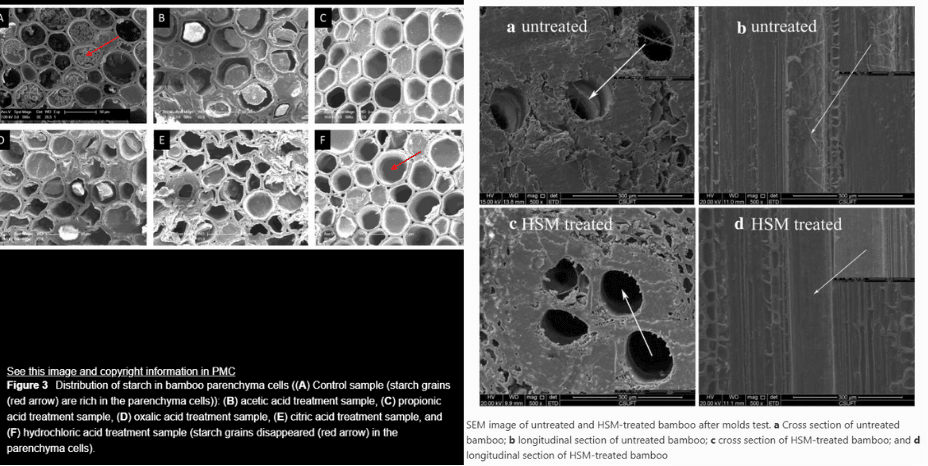
illustration of the effectiveness of commonly used methods for bamboo mold resistance according to research
Sources: Yu et al (2022) & Yang et al (2019)
Methods Still Undergoing Research
To ensure that HTR Bamboo leads in the sustainable production of bamboo panels, I see to it that we are informed of the latest research. The table below identifies methods that are still undergoing research and may be applied by the industry in the near future. These methods need more research to be widely applied in the industry.
| Research Reference | Method | Description |
|---|---|---|
| Li et al (2023) | Bio-based Antifungal Agents | Use of natural plant extracts and microbial metabolites to create eco-friendly, low toxicity mold prevention solutions
(examples: glycerol, monolaurate, phytol, carnauba wax) |
| Sun et al (2022) | Nanotechnology Coatings | Use of nano-titanium dioxide, nano-silver for self-cleaning, and antifungal coatings to enhance durability and sustainability |
| Zhang et al (2023) | Plasma Surface Modification | Use of low-temperature plasma to enhance bamboo’s density, water resistance, and mold resistance |
End-Users and Consumers
It is equally important for end-users such as retailers, warehouse owners and architects and consumers like home-owners to know the best practices for preventing mold, blackening, and moisture damage on their bamboo panels. Here are some evidence-based best practices that end-users and consumers can do:
Regular Cleaning Procedures
Clean and wipe dry bamboo panels to reduce avoidable moisture and contaminant exposure. Use a cleaner compatible with the cured finish and follow its data sheet; do not assume a household acid concentration prevents mold on every panel.
Effective Sealing and Finishing
Many manufacturers have recommended finishes or coatings for their bamboo panels. Regularly re-apply these solutions to maintain the bamboo panels’ protective coatings. Use only a coating or oil rated for the panel and intended exposure; a finish alone does not establish mildew resistance.
Anti-Mold Treatments
If an antifungal treatment is specified, follow the product label and panel supplier guidance. Inspect for wear and moisture conditions at a frequency suited to the use and exposure rather than a fixed interval.

eco-friendly and natural cleaners for bamboo panels
Commercial mold-risk review before ordering
Before an OEM panel quote, record the construction, thickness, finish, moisture target, storage and service environment, packaging, destination and sample-acceptance criteria.
- Environment: define humidity, direct-water exposure, temperature cycling, ventilation and installation details.
- Finish and treatment: use only a system compatible with the panel and destination; require the label, safety data and applicable test evidence.
- Verification: assess the approved sample and document the test conditions; research results do not guarantee the same outcome for every configuration.
- Commercial path: send the brief, quantity and destination for a written panel, finish, packing and document review.
Request a product- and environment-specific review →
Conclusion
Proper maintenance can help manage surface condition, but longevity and structural performance depend on construction, exposure, installation and maintenance. By understanding the causes of mold, blackening, and moisture damage, both industry professionals, end-users and consumers can adopt preventive strategies to preserve bamboo panels effectively. Scientific research highlights the importance of advanced treatment solutions, such as citric acid hydrolysis, silica gel coatings, and environmentally friendly copper-based preservatives. These approaches may influence mold resistance or moisture behaviour under tested conditions; results do not transfer automatically to every panel. For end-users and consumers, routine cleaning, sealing, and controlled environmental exposure are key practices in ensuring and prolonging the durability of bamboo panels.
For B2B partners, including exporters, importers and manufacturers, implementing best practices in bamboo panel treatment can significantly reduce product losses, enhance customer satisfaction, and strengthen brand credibility in the sustainable materials market. Ensuring that bamboo panels undergo proper preventive treatment before distribution adds value and reliability to your supply chain.
For end-users and consumers, adopting simple yet effective maintenance techniques—such as regular cleaning, applying protective coatings, and optimizing indoor conditions. These practices may help reduce avoidable exposure, but results depend on the panel, finish, environment and maintenance plan.
For a commercial specification, send the panel construction, finish target, storage or service environment, quantity and destination. HTR Bamboo can then confirm which bamboo plywood options and documents are available for that configuration.
For a written panel, finish, storage and destination review, use the RFQ path below. 🌿
Request a representative bamboo plywood sample before production →
Buying at volume? See HTR Bamboo’s logistics and lead times for B2B wholesale and OEM, or request a product- and environment-specific quote.
Share This Story, Choose Your Platform!
About the Author: HTR Bamboo Editorial Team

Related Posts
On this page
Need bamboo specifications?
Latest Posts
Copyright 2020 – 2030 HTR Bamboo
All Rights Reserved!

 English
  German
  Spanish
  Vietnamese