Quick answer: Plain-pressed bamboo shows a wider strip pattern; side-pressed bamboo shows finer lines; strand-woven bamboo uses compressed strands. Choose the appearance and the complete panel layup, then verify the sample against the finished part’s requirements.
Bamboo Plywood Types for OEM | Layup, Evidence & Applications

Choose the face style and the panel construction
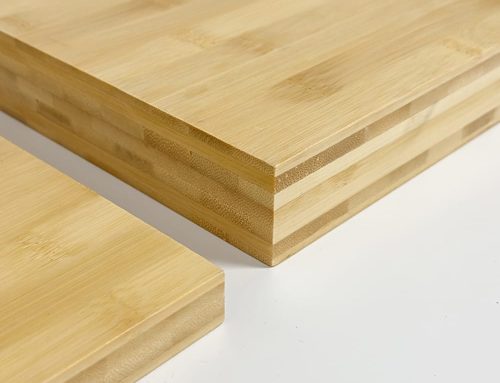
Plain pressed, side pressed and strand woven describe different bamboo material formats. To specify a panel, also define the layers underneath the face, their orientation and thickness, the adhesive and the finish. Two panels with the same surface pattern can have different edge appearance and machining behaviour.
Key differences in bamboo plywood types
| Type | How it is formed | What to inspect |
|---|---|---|
| Plain pressed / horizontal | Strips are joined with their broad faces forming the surface, giving a wider pattern with visible bamboo nodes. | Node placement, strip joints, colour range and the edge of the complete layup. |
| Side pressed / vertical | Strips stand on their edges, producing a finer, more closely spaced line pattern. | Line consistency, exposed edges, face selection and the proposed layer sequence. |
| Strand woven | Bamboo strands or fibre bundles are combined with adhesive and compressed into a dense material. | Specified density, machining response, finish and test results for that construction. |
On small screens, scroll the table sideways to compare the columns.
For an illustrated industry reference to strip orientation, see MOSO’s manufacturing explanation. Its proprietary product data should not be treated as a specification for an HTR order.
Durability: test the property your application needs
Surface hardness, bending performance, bond quality and moisture response are different properties. Higher density alone does not establish that a finished part will support a particular load or survive outdoor exposure. Ask for the relevant test method and report on the proposed material, then evaluate the part with its actual span, support and finish.
For a shelf or tabletop, agree the support arrangement and allowable deflection. For routed components, inspect the edge and fastener locations. For flooring, wet areas, food contact or exterior use, identify the product-specific testing and treatment requirements before choosing a material.
Appearance: approve a range, not only one chip
Compare plain-pressed faces when prominent nodes suit the design; compare side-pressed faces when a finer line pattern is preferred. Strand-woven material has a different, interlaced appearance. Review the actual colour and finish in your lighting, including both faces and any exposed edge.
Record acceptable colour variation, joints, repairs and face grading. Natural variation between boards should be represented in the approval set so one attractive sample does not become an unrealistic reference for the entire order.
Applications: start with the finished part
- Furniture and cabinetry: compare face style, edge appearance, fastener position, machining and the supported span.
- Wall panels and decorative parts: define visible surfaces, panel joints, fixing method and finish.
- Countertops: review cut-outs, support, edge sealing, finish and expected moisture exposure.
- Finished products: use the drawing and intended conditions to select the layup; do not substitute a different core based on appearance alone.
The furniture manufacturing guide explains how to carry these decisions into sampling and production. For coating choices, see the bamboo plywood finishing guide.
Cost and environmental evidence
Compare prices at the same panel size, layer construction, face grade, machining level, finish and quantity. Cutting yield and packing can change the cost of a finished part even when the sheet price looks similar. Use the processing cost guide to separate these items.
Request the evidence needed for the order: an eligible FSC sales claim, the relevant emissions report, or a product-specific environmental assessment where required. A research result for a different bamboo process does not establish the environmental performance of the quoted panel.
Decision guide: what to put in your enquiry
- Application, drawing revision and which faces or edges remain visible.
- Plain-pressed, side-pressed or strand-woven appearance, colour and finish.
- Complete layer sequence, core materials, size and finished thickness.
- Critical dimensions, tolerances, measurement conditions and inspection method.
- Sample purpose: appearance, machining, assembly or performance evaluation.
- Trial quantity, repeat quantity, delivery destination and required documents.
Request a quotation for your construction
Send these details to HTR Bamboo so we can review the material and sample options for the intended use.
Approve the sample record
Keep the drawing revision, material description, colour range, finish and measured results with the approved sample. Confirm any material or process change before releasing bulk production.
Confirm the complete panel composition
Ask which material forms every layer. An all-bamboo panel and bamboo veneer over a wood core can look similar while requiring different sourcing and import checks. Review the tariff and EUDR guide for the distinction.
For bulk and OEM orders, review the technical catalogs and wholesale bamboo plywood path, then request a quote with the application, construction, quantity and destination.
Share This Story, Choose Your Platform!
About the Author: HTR Bamboo Editorial Team

Related Posts
On this page
Need bamboo specifications?
Latest Posts
Copyright 2020 – 2030 HTR Bamboo
All Rights Reserved!

 English
  German
  Spanish
  Vietnamese